
The Appalachian Mountains stretch over 1,500 miles across the eastern United States, passing through 15 states from Maine in the north to Alabama in the south.
Known for their natural beauty, rich wildlife, and deep historical roots, the Appalachians are a beloved part of American culture and heritage.

The Appalachian Mountains stretch from Newfoundland, Canada, to Alabama in the southeastern United States. Shaped by millions of years of geological activity, the range is defined by rugged peaks, valleys, and ridges.
The Appalachians are split into three main subranges: the Northern, Central, and Southern Appalachians. The tallest peak is Mount Mitchell in North Carolina, standing at 6,684 feet above sea level. The landscape varies widely, from steep rocky cliffs to rolling hills and broad valleys.
The range is also home to a vast network of rivers, including the Tennessee, Ohio, and Susquehanna. These waterways have carved deep valleys through the mountains over time and remain vital water sources for surrounding communities.
Dense forests blanket much of the region, supporting a wide variety of plants and animals. Temperatures and conditions shift with elevation cooler and more temperate at higher altitudes, warmer and more humid in the lowland valleys. This diversity of terrain and climate makes the Appalachians one of North America’s most ecologically rich regions, with ecosystems ranging from deciduous forests in the north to temperate rainforests in the south.
The Appalachians were formed over 480 million years ago during the formation of the supercontinent Pangea. They are a result of the collision of three continents – North America, Africa, and Europe. This collision caused intense pressure, which resulted in the formation of these mountains. Over millions of years, the movements of tectonic plates and erosion have shaped the mountains into their current form.
The Appalachian Mountains are known for their rich and diverse plant and animal life. The vast range of elevation, climate, and habitats in these mountains supports over 400 species of trees, making it one of the most diverse forests in the world.
The Appalachians are also home to more than 250 species of birds, including the iconic bald eagle. In addition, various mammals, such as black bears, white-tailed deer, and bobcats, call these mountains their home. The Appalachians also have a high concentration of rare and endangered species, making it a critical area for conservation efforts.
The Appalachian Mountains offer endless opportunities for outdoor enthusiasts. With its vast land area, these mountains are perfect for activities such as hiking, camping, fishing, and skiing. One of the most popular activities in the Appalachian region is hiking on the Appalachian Trail, a nearly 2,200-mile trail that runs from Georgia to Maine. The trail attracts millions of hikers each year, seeking to experience the beauty and challenges of the Appalachian Mountains.
The Appalachian Mountains have a rich cultural history, with a diverse mix of Native American, European, and African influences. The mountain communities have passed down traditions such as music, dance, and food through generations, creating a unique Appalachian culture. The region also played a significant role in the American Civil War, with many historic battlefields and landmarks located within the mountains.
Despite their natural beauty and importance, the Appalachian Mountains face various challenges. Deforestation, development, and mining are some of the significant threats to these mountains.
These activities disrupt the delicate balance of the ecosystem, endangering the abundant wildlife and diverse plant life. To protect and preserve the Appalachian Mountains, conservation efforts have been made by organizations such as the Appalachian Trail Conservancy and The Nature Conservancy. These organizations work to maintain the natural resources and promote sustainable practices within the Appalachian region.
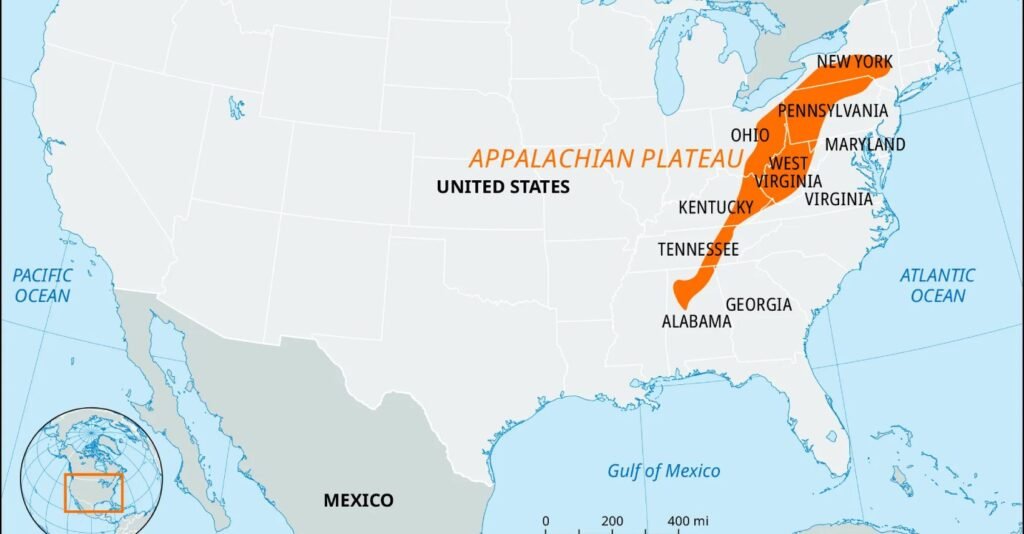
The Appalachian Trail spans 15 states, each with its own unique landscapes and challenges. The southern portion (starting in Georgia) is steep, rocky and secluded. The AT is the ultimate form of extreme hiking. The trail, which runs approximately 2,190 miles (3,540 km), traverses 15 US states.
The Appalachian Mounatain States are: Maine, New Hampshire, Vermont, Massachusetts, Connecticut, New York, Pennsylvania, Maryland, West Virginia, Virginia, Kentucky, North Carolina, Tennessee, Georgia, and Alabama.
The southern section of the Appalachians includes North and South Carolina, Tennessee, Georgia, and Alabama.
Georgia: The trail begins at Springer Mountain in the Chattahoochee National Forest.
North Carolina: It enters the state just south of Hiawassee and heads through the Great Smoky Mountains National Park.
Tennessee: The route traverses the Cherokee National Forest and the Great Smoky Mountains National Park.
The central section of the Appalachians includes Pennsylvania, Maryland, Virginia, and West Virginia.
Virginia: This trail is the longest in Virginia, traversing the George Washington and Jefferson National Forests.
West Virginia: It crosses into West Virginia, just a little bit near Harpers Ferry, the town that is deemed the psychological midpoint of the trail.
Maryland: The path winds through Maryland, passing by a couple of historic sites.
Pennsylvania: It passes through eastern Pennsylvania, where the landscape is rugged.
New Jersey: The trail winds through the Delaware Water Gap National Recreation Area.
The northern section of the Appalachians extends through the northeastern United States. It included the states of :
New York: The AT passes New York’s Hudson Valley and the Appalachian Trail Metro-North Railroad Station.
Connecticut: The trail crosses the state line and skirts a section of the Housatonic River Valley.
Massachusetts: It enters the state across the Berkshires, near Salisbury.
Vermont: The route enters Vermont, near the Massachusetts border.
New Hampshire: The trail winds through the White Mountains National Forest, which is rugged.
Maine: The trail comes to an end at Mount Katahdin in Baxter State Park, where the Appalachian Trail meets up with the north.
The Appalachian Trail, often called the “A.T.”, is a 2,190-mile hiking trail that runs from Georgia to Maine. It takes approximately 5-7 months for a hiker to complete the entire trail, with the average being around 6 months. The time it takes to complete the trail depends on various factors like the hiker’s physical fitness, pace, and weather conditions.
Hikers must also navigate dense forests and cross streams and rivers along the way. The middle section, covering North Carolina, Tennessee, and Virginia, is known for challenging elevation changes, steep climbs, and exposed ridges. The northern section, starting from Pennsylvania, features rugged terrain, rocky ridges, and high elevations.
Hikers on the Appalachian Trail also have to consider various factors that can impact the length of their journey. Weather conditions, such as extreme heat, heavy rain, or unexpected snowstorms, can slow down a hiker’s pace and add more time to their journey. Injuries or illnesses can also delay a hiker’s progress, and they may need to take breaks or even leave the trail for medical attention.
It is essential for hikers to plan and prepare before embarking on a journey on the Appalachian Trail. This can include physical training, acquiring necessary gear, and studying the trail’s terrain and weather conditions for their desired time frame. Many hikers aim to complete the trail within a specific time frame to beat the record of the fastest known time (FKT).
September 21 2024 : 189 Miles, 40 Days, and 3 Showers: How Tara Dower Destroyed the Appalachian Trail Speed Record
Eating Snickers bars and drinking from streams, Tara Dower raced through the Appalachian Trail at record-breaking speed. From Georgia to Maine, Dower hiked the 2,189 miles in just 40 days, demolishing the previous female speed record by a staggering 1 days. And she did it all with only three showers.
Dower had always been an avid runner and hiker, but she had never attempted anything as daunting as the Appalachian Trail. The thought of conquering the trail and making history motivated her to start training and preparing for the ultimate challenge.
Dower’s average day consisted of waking up before sunrise and hiking until about 8pm. She would cover 50-60 miles per day, with very few breaks and a quick lunch on the go. Her diet consisted of mostly trail mix, energy bars, and dehydrated meals, with the occasional treat of a Snickers bar or fresh fruit from trail angels.
The physical toll of the trail was intense and Dower had to push through pain and exhaustion. She dealt with blisters, bruises, and sore muscles, but refused to let them slow her down.
But it wasn’t just the physical challenges that Dower had to overcome. The mental challenge of spending 40 days alone in the wilderness, facing unpredictable weather and treacherous terrain, was just as tough. But Dower’s determination and mental toughness propelled her one step at a time.
The Appalachian Trail offers not just a physical challenge, but also a mental and emotional one for hikers. It takes determination, perseverance, and resilience to complete the trail. Hikers often develop a sense of camaraderie and community on the trail, forming bonds with fellow hikers and trail volunteers.
The Appalachian Mountains and Mount Kilimanjaro are two of the most iconic mountain ranges in the world. While both offer stunning landscapes and challenging terrain, there are significant differences between the two.
The Appalachian Mountains stretch over 1,500 miles and have a maximum elevation of 6,684 feet. In comparison, Mount Kilimanjaro is the tallest mountain in Africa, standing at 19,341 feet. While the Appalachians are spread over 12 states in the eastern United States, Kilimanjaro is located in Tanzania.
The Appalachians formed over 480 million years ago during the assembly of the supercontinent Pangea. Built mostly from sedimentary rock, they have been shaped over time by tectonic shifts and erosion. Mount Kilimanjaro, by contrast, is a dormant volcano made up of three volcanic cones. Its high elevation gives it a distinctive snow-capped peak.
Due to its location near the equator, Mount Kilimanjaro experiences a tropical climate, with temperatures ranging from 20-25 degrees Celsius. The Appalachian Mountains have a temperate climate, with temperatures varying widely depending on the elevation and season.
In the southern section, temperatures can reach as high as 35 degrees Celsius in the summer, while in the northern section, temperatures can drop below freezing in the winter.
Both the Appalachian Mountains and Mount Kilimanjaro offer a range of outdoor activities, including hiking, camping, and wildlife viewing. However, the level of difficulty and terrain in these activities differs significantly.
The Appalachian Trail offers a challenge to hikers with its steep ascents and rocky terrain, but it does not require technical training or equipment. On the other hand, climbing Mount Kilimanjaro does not require technical skills but involves high-altitude climbing and may require acclimatization to avoid altitude sickness. You also need physical fitness and proper gear to safely summit the peak.
Another significant difference between these two mountain ranges is their cultural and historical significance. The Appalachians have a rich cultural history, influenced by Native American, European, and African traditions.
In contrast, Mount Kilimanjaro is a holy mountain for the Chagga people of Tanzania and holds spiritual significance. It is also a popular destination for adventure-seekers and has a long history of climbers attempting to reach its peak.
In short, the Appalachian Mountains and Mount Kilimanjaro are both breathtaking and adventure-filled, but each is distinct in its geology, climate, and cultural significance.
Whether hiking on the Appalachian Trail or Hiking Mount Kilimanjaro, these mountains offer incredible experiences for all outdoor enthusiasts.