
Thousands of people flock to Mount Everest each year, hoping to summit the world’s most famous mountain. Sadly, not all of them make it back. When you’re climbing a mountain that’s 8,849 meters tall, accidents happen. Sometimes bad weather rolls in, sometimes climbers get injured, and a lot of the time, oxygen is limited. On Everest, it’s always life or death.
Let’s dive into the tragic stories of Mount Everest and look at just how many people have perished during the climb. At the end of the article, we’ll compare the statistics of Kilimanjaro to give an idea of their similarities and differences.
Grab your climbing gear, and let’s go!
Mount Everest is a part of the Himalayan Mountains, sitting along the border between Nepal and China. The peak is shared by both countries, but the most well-known summit route is on the Nepal side. Hikers usually fly from Nepal’s capital, Kathmandu, to the small mountain town of Lukla.
The Lukla airport is known for being one of the most dangerous in the world. Why? Well, the runway is short, the visibility is poor, the wind is severe, and the altitude is high. Most runways are around 3,000 meters long, while Lukla’s is just 527 meters. There have been around a dozen accidents at the airport and dozens of fatalities.
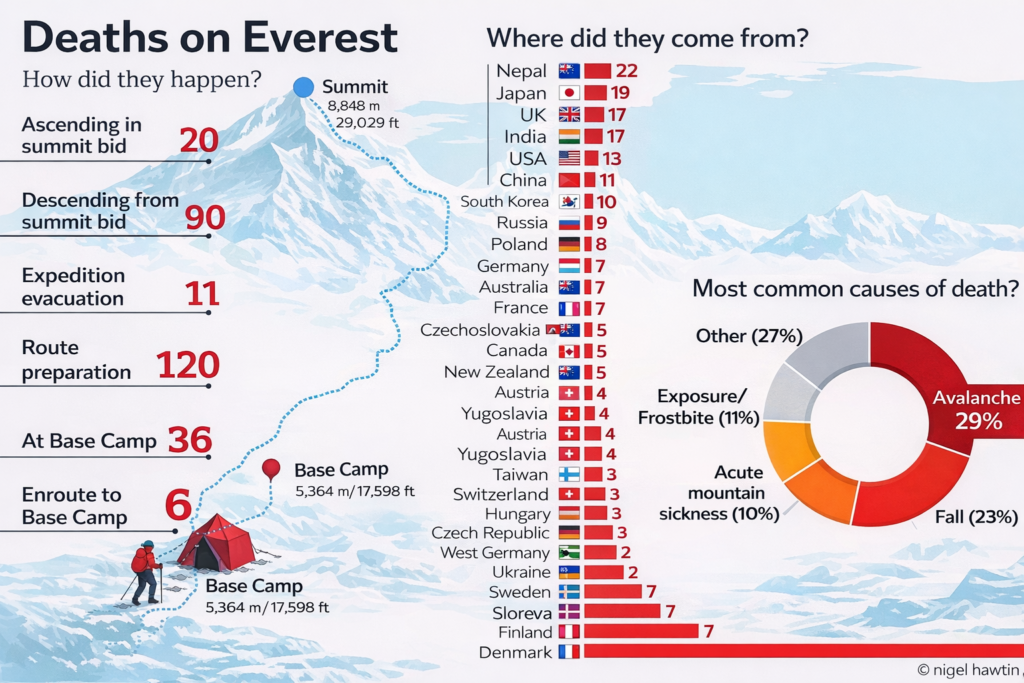
According to the Himalayan database, at least 322 people have perished on Mount Everest since records began in 1922, averaging out to about 4.4 deaths per year and that number slowly ticks up each year.
The first summit of the mountain was in 1953. So, that means four to five people have died there each year since then. But, in reality, not many people attempted to climb the mountain until the 1990s, when commercial trips started to be offered.
The single deadliest day occurred on April 25th, 2015. A 7.8-magnitude earthquake resulted in the deaths of 19 people at the base camp. Another tragic day happened on April 14th, 2014, when an avalanche took out 16 Nepali climbing guides. The two devasting days have gone down in history.
The death rate from climbing Mount Everest in the last 30 years sits at about 1%. The percentage of deaths to successful attempts is around 4%. So, all in all, your chances of dying while climbing the mountain are slim; however, that’s only the case if you are properly prepared and climbing with a professional guide. Not to mention, when things go wrong, they go very wrong. It would be a mistake to conclude that summiting Everest is a walk in the park because of the low death rate.
According to the climbing community, to date, an estimated 300 people have died climbing Mount Everest, with approximately 200 bodies still on the mountain. Some of the dearly departed are visible on the mountain, while others are forever lost.
It’s not uncommon to walk over frozen bodies while summiting Mount Everest. But why aren’t they being removed?
Recovering bodies is risky and expensive. Once you get into the mountain’s highest section, referred to as the death zone (see more below), bodies quickly freeze into the mountain. The task is far too demanding, and good weather conditions only last for so long.
In general, more accidents happen on descents rather than ascents. That’s because climbers are already exhausted and complacent, and the chances of bad weather are higher. But Mount Everest may be breaking this rule.
A large study looked at all the climbs up to 2006 and verified that more than half of the deaths happened during the descent. However, new claims are being made that ascending is now responsible for a majority of the fatalities (an updated study has yet to be published).
Getting to the top of Mount Everest takes about six weeks as people have to acclimate to the high altitude. That’s a long time for accidents to happen. On the other hand, descending from the summit to base camp only takes a couple of days. But no matter if you’re going up or down, extreme caution needs to be taken.
The most common causes of death on Mount Everest are acute mountain sickness, falls, avalanches, exhaustion, crevasses, exposure, and hypothermia. Long list, right? Well, when you’re climbing above 8,000 meters, a lot can go wrong.
Acute mountain sickness and exhaustion are believed to be the leading causes of death on the mountain. The high altitude can lead to cardiac arrests and strokes, and minor injuries can become a death sentence. Additionally, when climbers aren’t feeling well or are extremely fatigued, errors are more likely to occur.
Located in the highest regions of the mountain, the death zone presents climbers with extreme cold, dangerously low oxygen levels, and inhospitable conditions. As climbers ascend higher, they must carefully monitor their physical well-being and mental state to mitigate the risks.
The lack of oxygen in this high-altitude region can lead to hypoxia, frostbite, exhaustion, and severe altitude sickness. Add to this the unforgiving terrain and unpredictable weather patterns, and the risks are magnified. Climbers must move diligently yet swiftly to minimize their exposure to the deadly conditions.
The death zone refers to the section of the mountain above 8,000 meters. In this zone, oxygen pressure is extremely low, and humans are unable to stay for long without having a supply of oxygen. Experts don’t recommend anyone stay in the death zone for more than 16 to 20 hours.
Oxygen isn’t the only thing you have to worry about.
At the highest part of the mountain, climbers are highly exposed, leading to frostbite and snow blindness. Summiting is also the most strenuous section, which means the chances of accidents are at an all-time high.
So, if you do climb Mount Everest, be prepared for the death zone.
Successfully scaling Mount Everest requires a delicate balance between pushing one’s limits and prioritizing safety. Proper acclimatization and adequate nutrition are essential components of a successful ascent. However, exercising caution, sound judgment, and resilience in the face of challenges is equally critical. Should one aspect falter, the consequences can be deadly.
The high-altitude environment and extreme conditions make it challenging to retrieve bodies from Everest’s slopes. It is highly inefficient, impractical, and dangerous to move frozen bodies, which can weigh over 300 pounds (136 kg).
To make matters more challenging, the unpredictable weather and logistical complexities make body recovery missions on Everest a perilous task that requires specialized skills and equipment.
Some people have lost their lives while trying to recover bodies on the mountain. As a result, most fallen climbers remain on Everest, serving as a reminder of the dangers that lie ahead.
One area on the mountain’s northeastern ridge route, known as Rainbow Valley, is a critical point for climbers ascending or descending via the North Col route. It has earned its name not for its natural beauty, but for the colorful down jackets of fallen climbers strewn across its landscape. To date, an estimated 300 people have died attempting to climb Mount Everest, with approximately 200 bodies still on the mountain.
The vast diversity of the deceased climbers on Everest paints a picture of the adventurers who sought to conquer the world’s highest peak. Each fallen climber left a story that speaks to the allure and danger of Everest.
Perhaps the most famous of the fallen climbers is Green Boots, believed to be Tsewang Paljor. He lost his life during the ill-fated 1996 Everest expedition involving the Indo-Tibetan Border Police team from India.
The name Green Boots refers to the green Koflach mountaineering boots he wore. Paljor and his team were caught in a blizzard just short of the summit. While three members turned around, Paljor and two others decided to continue. They never made it back.
Green Boots became a landmark on the main Northeast ridge route until his body was eventually moved in 2014. The 1996 disaster claimed the lives of eight climbers and raised concerns about the commercialization of Everest climbs.
Francys Arsentiev was an experienced climber who lost her life on Everest in May 1998. She and her husband, Sergei Arsentiev, were attempting to summit without supplemental oxygen. Despite reaching the summit, difficulties on the descent proved fatal for both, with HACE (high-altitude cerebral edema) likely contributing to their deaths. Francys’ final words, “Don’t leave me,” added a deeply human element to the tragedy.
Fancys gained the nickname “Sleeping Beauty of Everest” due to her striking appearance. As she lay on the mountain, she looked as peaceful as if she were asleep. The harsh conditions had left her skin pale and waxen. After nine years, her body was finally discovered and recovered in 2007.
George Mallory was a British mountaineer who disappeared during his 1924 Everest expedition. His body was not discovered until 1999, leaving the details of his final hours largely speculative.
Evidence suggests he suffered a fatal fall, with severe head wounds and a severe rope-jerk injury around his waist found during recovery operations. Mallory was said to have promised to place a photo of his wife on the summit, which was never found, fueling the mystery about whether he and climbing partner Andrew Irvine reached the top before perishing.
Scott Fischer, an experienced American mountaineer and guide, died during the infamous 1996 Everest disaster. He was the leader of the Mountain Madness expedition, one of several groups attempting the summit on the same day.
Despite reaching the summit late in the afternoon, he suffered from HACE on the descent and could not make it back. Despite the efforts of fellow climbers and Sherpas to assist him, he passed away near the South Summit.
David Sharp was a British mountaineer who met a tragic end during his solo attempt to summit Everest in 2006. He succumbed to a combination of hypothermia, altitude sickness, and oxygen deprivation on the mountain’s north side.
Despite over 40 climbers passing by him on the night of his death, only a few attempted to help, raising questions about moral obligations in such situations.
Hannelore Schmatz was the fourth woman to reach Everest’s summit and the first woman to die on the mountain. She died in a bivouac near the summit in 1979 while on an expedition with her husband.
Despite the efforts of their Sherpa guides to convince them to move, they stayed put, exposed to extreme weather conditions that proved fatal. Her body used to sit as a landmark on the mountain, but eventually disappeared due to natural forces.
Shriya Shah-Klorfine was a Nepali-born Canadian mountaineer who died on Everest in 2012. Her summit attempt coincided with a crowded season, and she became caught in bottlenecks on the way to the top. Despite reaching the summit, exhaustion and lack of oxygen proved too much on the descent.
Kilimanjaro is about 3,000 meters shorter than Mount Everest. But how does the death rate match up? Well, the good news is that Kilimanjaro’s death rate is only .03%. So, of the 30,000 people who climb the mountain each year, around ten people die. The leading case of death is typically altitude sickness, preexisting health conditions, or falls.
Hiking to the top of Kilimanjaro with a reputable company like Hiking Kilimanjaro is the best way to ensure you summit safely. Professional guides will be there every step of the way and monitor the condition of each hiker. The mountain is a wonderful and safe option for anyone interested in taking on a mountain that’s almost 6,000 meters!